Web3 & Decentralized Applications (DApps)
1. what is Web3 & Decentralized Applications (DApps)?
.jpg)
Web3 refers to the next generation of the internet, where decentralization, blockchain technology, and user ownership are at the core. Unlike Web2—which relies on centralized platforms like social media and cloud services—Web3 enables users to own, control, and interact with digital assets without relying on intermediaries. This is achieved through blockchains, cryptocurrencies, and smart contracts, allowing for peer-to-peer transactions and transparent data sharing. Web3 aims to create a more private, secure, and user-centric internet.
Decentralized Applications (DApps) are software programs that run on a blockchain rather than a centralized server. They use smart contracts—self-executing agreements coded on the blockchain—to facilitate automated and trustless transactions. DApps can be used in various fields, including finance (DeFi), gaming, social media, and supply chain management. For example, in DeFi, DApps enable users to lend, borrow, or trade cryptocurrencies without a bank. This removes the need for intermediaries and provides greater financial access worldwide.
The key benefits of Web3 and DApps include user privacy, data security, and censorship resistance. Since DApps operate on public blockchains, they are transparent and immutable, meaning data cannot be altered or deleted. However, scalability, user adoption, and regulatory concerns remain challenges for widespread implementation. As technology evolves, Web3 and DApps have the potential to reshape how people interact with the digital world by empowering users and removing centralized control.
2.Metaverse
Metaverseis a virtual, interconnected digital world where users can interact, socialize, work, and play using augmented reality (AR), virtual reality (VR), and blockchain technologies. It blends the physical and digital worlds, allowing users to create avatars, explore virtual spaces, and engage in real-time activities. This digital environment includes virtual offices, gaming worlds, education platforms, and even virtual marketplaces where users can buy and sell digital assets like NFTs (Non-Fungible Tokens).
One of the key features of the Metaverse is immersion—users can experience 3D environments and interact with others in real time. Technologies like VR headsets, AR glasses, and haptic devices enhance the experience by providing sensory feedback. For instance, in a virtual meeting, you can sit around a digital conference table with colleagues from around the world. In gaming, the Metaverse allows players to explore vast virtual landscapes and own in-game assets that can be traded or sold.
The future of the Metaverse holds vast potential in various industries. In education, it enables immersive learning experiences through virtual classrooms. In healthcare, professionals can perform virtual surgeries for training. The entertainment industry can offer virtual concerts and events. Despite its promises, challenges like privacy, security, and digital inequality need to be addressed. As technology advances, the Metaverse is expected to become a central part of how people live, work, and connect globally.
3. Decentralized Identity
Decentralized Identity is a user-centric approach to managing personal information where individuals control and own their digital identities without relying on a central authority like a government or social media platform. It uses blockchain technology and cryptographic principles to securely store and share identity data. This allows users to manage credentials such as passports, driver’s licenses, and certificates in a tamper-proof and verifiable way. Unlike traditional identity systems where organizations hold user data, decentralized identity gives users full ownership and the ability to share only the information they choose.
One of the main technologies behind decentralized identity is Self-Sovereign Identity (SSI). It enables users to create a digital identity wallet where verified credentials are stored. For example, instead of giving your entire identity document for age verification, a decentralized system allows you to share only the proof of age. This reduces the risk of data breaches and identity theft. Organizations use Decentralized Identifiers (DIDs) and Verifiable Credentials (VCs) to authenticate users securely while respecting their privacy.
The advantages of decentralized identity include greater privacy, data security, and user empowerment. It is already being used in financial services for KYC (Know Your Customer) verification, education for digital diplomas, and healthcare for medical records. As this technology evolves, it could become a global standard for secure and private digital identity management, reducing the risks of centralized data storage while giving users more freedom and control over their information.
4.Decentralized Autonomous Organizations (DAOs)
Decentralized Autonomous Organizations (DAOs) are community-led organizations governed by smart contracts on a blockchain. Unlike traditional organizations with centralized leadership, DAOs operate without a single authority. Instead, decision-making is handled through voting by token holders, ensuring transparency and community participation. DAOs are commonly used for managing investment funds, charities, and digital platforms, allowing users to collaborate and control resources without intermediaries.
At the core of a DAO are smart contracts, which are self-executing programs that define the organization’s rules and automatically enforce them. Members typically hold governance tokens, which allow them to propose and vote on decisions like fund distribution, project priorities, and policy changes. For example, in a crypto investment DAO, members can vote on which blockchain projects to invest in. The more tokens a member holds, the greater their voting power.
The benefits of DAOs include transparency, inclusivity, and automation. Since decisions are recorded on the blockchain, they are publicly verifiable, reducing fraud risks. Additionally, DAOs remove the need for middlemen, lowering costs and increasing efficiency. However, they also face challenges like legal uncertainty, voting manipulation, and security vulnerabilities in smart contracts. Despite these risks, DAOs are transforming how communities organize, govern, and distribute shared resources.
.jpeg)
5.Web3 Browsers
Web3 Browsers are advanced web browsers designed to interact with decentralized applications (DApps) and blockchain networks. Unlike traditional browsers that access centralized websites, Web3 browsers allow users to engage with the decentralized web securely. They integrate blockchain technology to provide features like cryptocurrency wallets, smart contract interactions, and token management. Popular examples of Web3 browsers include Brave, Opera Crypto Browser, and MetaMask (browser extension), which enable users to access blockchain-based platforms directly.
A key feature of Web3 browsers is their ability to support crypto wallets, allowing users to store, send, and receive digital assets without relying on third parties. These browsers also provide secure and private browsing experiences by avoiding centralized data tracking. For instance, Brave Browser rewards users with Basic Attention Tokens (BAT) for viewing ads while maintaining their privacy. Additionally, Web3 browsers can interact with Ethereum Virtual Machine (EVM)-based networks, enabling decentralized finance (DeFi) activities, NFT trading, and staking directly from the browser interface.
Web3 browsers play a crucial role in the adoption of blockchain technology by providing a user-friendly gateway to the decentralized internet. They offer enhanced security through encryption and user-controlled keys, minimizing the risks of data breaches and surveillance. As the Web3 ecosystem grows, these browsers will continue to evolve, supporting more blockchains, improving user experience, and fostering a truly decentralized and permissionless internet.
6.Peer-to-Peer Networks
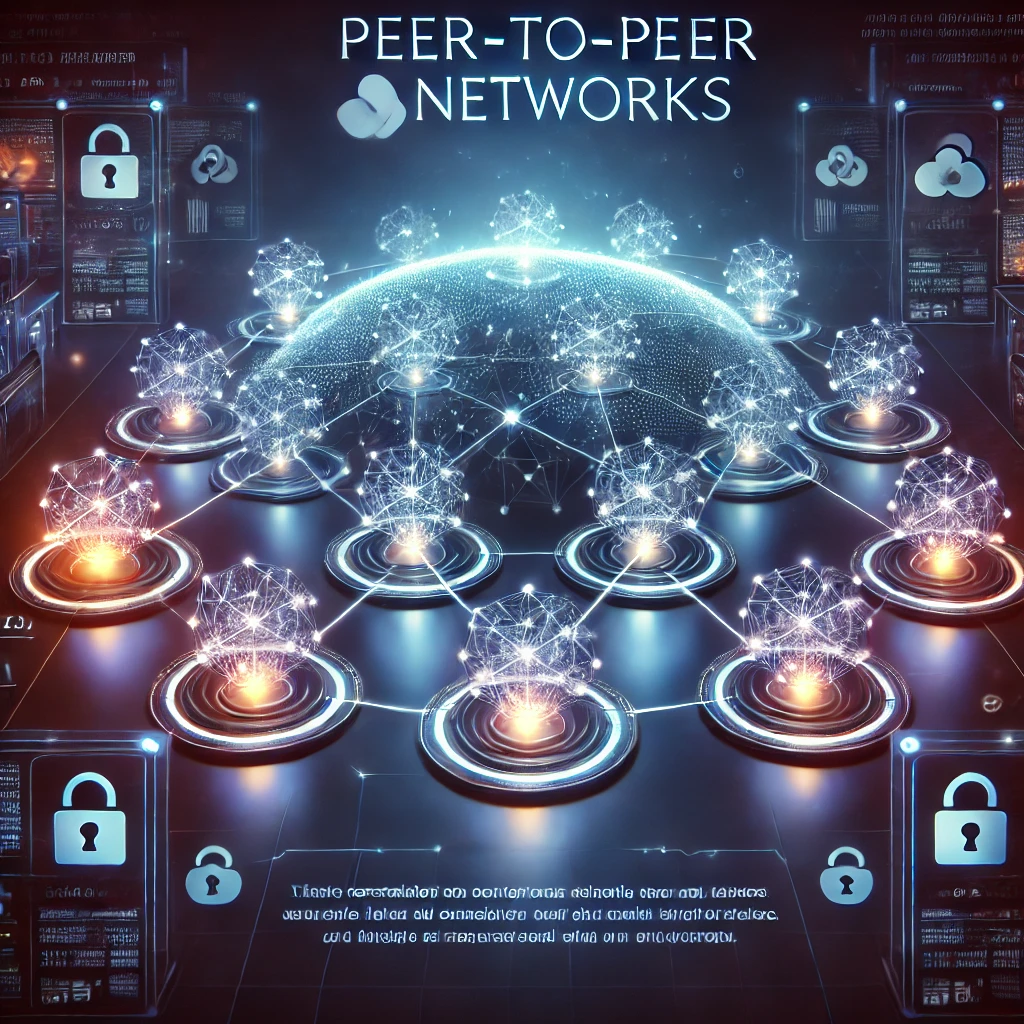
Peer-to-Peer Networks network is a type of decentralized network where devices, known as peers, communicate directly with each other without relying on a central authority or server. Each device in the network can act as both a client (requesting services) and a server (providing services). This structure makes P2P networks more resilient, scalable, and efficient for sharing resources like files, data, and computing power. Popular examples include BitTorrent for file sharing and blockchain networks for cryptocurrency transactions.
In P2P networks, data is distributed across multiple devices rather than being stored in a central location. This improves fault tolerance, meaning if one peer goes offline, the system remains functional. P2P networks can be classified into two main types: Unstructured (where peers connect randomly) and Structured (using algorithms to organize connections). Bitcoin and other blockchain systems use structured P2P networks to maintain a consistent and secure ledger of transactions without a central authority.
P2P networks offer several advantages, such as increased privacy, reduced costs, and no single point of failure. However, they also face challenges, including security risks like data tampering and distributed denial-of-service (DDoS) attacks. Despite these risks, P2P networks remain vital for decentralized applications, file sharing, and cryptocurrency systems, offering users more freedom and control over their data. As technology advances, P2P networks will continue to play a critical role in shaping the future of the decentralized internet.
7. Filecoin & IPFS
Filecoin & IPFS are complementary technologies designed to decentralize file storage and retrieval on the internet. Both aim to reduce reliance on centralized servers, providing a more secure, efficient, and censorship-resistant way to store and access data.
IPFS (InterPlanetary File System)
OPFS is a peer-to-peer (P2P) protocol that allows users to store and share files across a distributed network. Instead of traditional location-based addressing (like URLs), IPFS uses content-based addressing, where each file is assigned a unique cryptographic hash. When a user requests a file, IPFS locates the peers with that hash and retrieves the data. This method ensures faster data access, reduces duplication, and enhances data integrity. IPFS is widely used for decentralized websites, archiving, and content delivery, providing a more robust and efficient alternative to conventional storage systems.
Filecoin
Filecoin is a decentralized storage network built on top of IPFS. It incentivizes users to rent out their unused storage space and earn Filecoin (FIL) tokens. Users who need storage pay in FIL to securely store their data across multiple providers. Miners in the Filecoin network validate data using Proof-of-Replication (PoRep) and Proof-of-Spacetime (PoSt), ensuring stored data is accurate and available over time. This system creates a marketplace for storage where prices are determined by supply and demand, offering a cheaper, scalable, and resilient alternative to centralized cloud services.
Relationship Between Filecoin & IPFS
While IPFS provides the foundation for storing and sharing content in a decentralized way, Filecoin adds an economic layer that rewards participants for providing storage. Together, they empower users to store, retrieve, and verify data in a secure, distributed, and cost-effective manner. This combination is paving the way for decentralized applications (DApps), permanent data storage, and reducing the control of major cloud providers over global data.
8. Play-to-Earn Gaming
Play-to-Earn Gaming is a revolutionary model where players can earn real-world value by participating in video games. Unlike traditional gaming, where in-game rewards are limited to the virtual world, P2E games allow players to collect cryptocurrencies, tokens, and digital assets that can be exchanged for real money. This model is powered by blockchain technology, which ensures the security and authenticity of in-game assets. Players can earn rewards by completing tasks, battling other players, or contributing to the game’s ecosystem. These earned assets are often represented as NFTs (Non-Fungible Tokens), which give players true ownership and the ability to trade or sell them on various platforms.
In P2E games, players can earn through various activities such as farming resources, winning battles, or building virtual properties. These earned tokens can be converted into cryptocurrencies like Ethereum or stablecoins, allowing players to cash out their virtual earnings. Popular P2E games include Axie Infinity, The Sandbox, and Decentraland, which offer immersive experiences where players not only enjoy the gameplay but also generate income. This gaming model has gained popularity worldwide, especially in developing regions where players view it as a new source of livelihood. By combining entertainment with financial incentives, P2E gaming has transformed how people perceive and engage with virtual worlds.
While P2E gaming offers exciting opportunities, it also comes with challenges. The value of in-game assets can be volatile, affecting the financial returns for players. High entry costs in some games may prevent new players from participating. Additionally, concerns around regulatory frameworks and market manipulation pose risks to the long-term sustainability of these games. Despite these challenges, the future of P2E gaming remains promising as it continues to evolve and attract a global audience. As technology advances and new models emerge, P2E gaming is expected to reshape the gaming industry by offering players both entertainment and economic empowerment.
Comments